Crazy, I know.

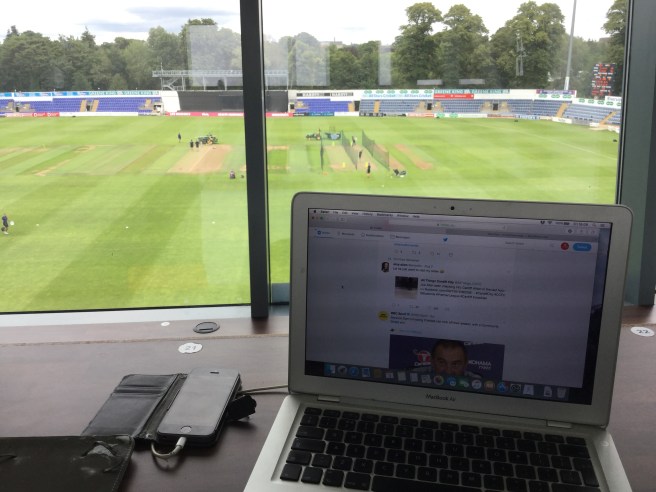
Lunchtime in Wales. The twittersphere tells me Rashid Khan can’t play tonight for Sussex – a plus.

But given the Sharks (I kinda resent calling them that but let’s go with the faux I mean flow, eh?) have maybe the most fangtastic attack in the tournament in any case, the chances for a Middlesex win at Hove prolonging Glammy’s season remain slim, yes? Sussex still have Archer, Jordan and Mills and are therefore odds-on to endstop Eoin Morgan’s campaign with another emphatic disappointment.

Or are they?

T20 does have scope for that turn-on-a-tanneresque, wtf-acious, well I ne-ver in a-all my born days jolt. It’s arguably predicated on thrills and dramatic holy cows; lurid ones, inflatable ones – ones with a microphone or megaphone. Meaning it’s a rush. 

Me, I’m in a flush. Because if you didn’t know it, my lot – our lot – Glamorgan are scrambling. They must win tonight and hope Sussex lose.

Sussex are at home to the worst team in the division. Glam have Surrey at Sophia Gardens. There may even be a weather issue, possibly, in Cardiff, which could scupper that 2 points imperative. It’s feeling cruel and ecstatic and BIG, all this. We love it and it’s almost unbearable.

If you’re like me you start wondering fatally aloud and quite probably pontificating to people in bars, or caffs or kitchens. Trying to un-mist those memories around How, Exactly It Came To This.

We blame shot selection, rank amateurism, villageism, inexperience and the coach. We know we are right even when at our most nailed-on preposterous but our love of An Opinion drives us on. Our hunches become Mona Lisas; unshiftable and mighty and true; stars in the firmament of revelation.

This is the essence of supporting stuff: knowing that our professionals haven’t got a clue.

It’s ingloriously bastardly. It’s hilarious – it drives the coaches, players and opposition mad. The utter cobblers we come out with.

Ah but it’s rejuvenating and self-validating and joyfully daft, too. It’s the essential matrix – and you bloody coaches and CEOs and players better remember this! – without which public sport itself is dead. Fans mithering or bawling or making extraordinarily, brilliantly astute contributions. It’s the game.

Hey before I get into that pre-pre-game period – where it’s too early to get hyper and too late for calm – let me leave you with the wildest daftest contribution my own allegedly-plainly free-wheelingly absurdist cerebellum came up with the other day. During that massacre at Hove.

Staggering-but-true there was a moment in that Sussex v Glam game where the visitors were if not cruising then on that most delicious cusp. Chasing a reasonable lump, Donald and Meschede had gone in and made a magnificent start. Donald (I think) got out, bringing Ingram in. But Glam had been going at something close to 12 an over. And Ingram is almost god.

In my infinite but delusional, inexperienced, unreliable wisdom I was certain that the spectacular South African could play within himself for ten overs and still score at more than the required rate, thus guiding Glam to an uncomplicated but tremendously significant win. Instead, he crashed one to the fielder.

I tweeted something to the effect that Ingram – Glam’s rock and leader and inspiration – had arguably thrown away the campaign; right there. In a flashy, unnecessary moment. (To be fair I was careful not to accuse the man of anything but you get the drift).

I kinda love Colin Ingram but I still (secretly until now) believe he was wrong… and that my own intuit-o-cobblers was right. He’s so good he could have picked and cut and nurdled or watchfully-downwardly boomed his way to the win. He could: I believe that.

And that, my friends, is both a confession of sorts and a statement of my vain, inviolable prerogative – and yours. Over a season where eight zillion more obvious errors or misjudgements patently out-rank this embarrassing hunch of mine, we reach the last, fatal knockings with me wondering on this. Crazy, I know.


Come ON Glam!


The Universe Podcast 2: with Matt Thompson, Talent Programme Manager for Cricket Wales

DDC91EB1-C951-4E80-93E6-482D8F6E1586

In the second of my amiable meanderings through what-might-turn-out-to-be the Definitive List of Movers & Shakers in Welsh Cricket, I chat to Matt Thompson, Talent Programme Manager for Cricket Wales.

Matt is a brilliant 26 year-old cricketer/lecturer/coach, with a ridiculous c.v.

Despite this, I kinda liked him. We talked the new job through – criminally unedited – plus all kinds of coach-feely other stuff.

Have a listen.


The Universe Podcast 1. @cricketmanwales meets Mark O’Leary… & talks MCC University Cricket.

Please note that this post is very much a companion piece to the preceding feature – On #firstclasscricketersfirstclassdegrees.

I spent some time with Mark O’Leary – Head Coach at Cardiff MCCU.

It’s not what you might call hard-hitting journalism. In fact it’s not journalism. I like the bloke; we talked.

O’Leary is something of a rising star – ECB Elite Master Level 4 Coach, workshop maestro, deviser of wittily wicked drills – who combines the cricket role with teaching on the Cardiff Met academic staff.

We talk about everything from funding, to honoured alumini, to the future for the scheme. Have a listen.

The sharp-eared may notice mention of £76,000 at the ver-ry end of the discussion. This of course related to Mr O’Leary’s fee.


On #firstclasscricketersfirstclassdegrees.


This slideshow requires JavaScript.

Friends we can be pretty sure that Messrs Bayliss and Farbrace don’t order the kit, sort the stop-overs, book the buses and the umpires. They don’t frame their work around ‘equally important’ other stuff – for the players, I mean – academic stuff. Mark O’Leary does.

He does because he’s the Head Coach at the Cardiff M.C.C. University Scheme. This as many of you will know is the project that for two decades has offered both a route in to professional cricket *and* the safety net of a university education.

Initiated by the inimitable Mr G Fowler Esquire of Durham and now based around six centres across England and Wales, the scheme has played a significant role in the careers and indeed the lives of (to take current figures) some 26% of county cricketers.

But even this apparently strong result in the value-for-money department has not rendered the project immune from the administrative/cultural/fiscal or accountability-driven revolutions carving and helicopter-shotting their way through the cricket landscape.

Recent features of that hypnotic but not always helpful flux include the M.C.C. pulling out after years of noble and very much-appreciated support, business (i.e. Deloitte) pulling in, and – within the last week or so – the E.C.B. confirming that they will bankroll things, post 2020.

There had for many us been a sense that after years of low-level uncertainty, a clear, bomb-proof structure needed to be in place and that if there can be such a thing, the ECB (the original funders) seemed the natural sponsor. However just how bomb-proof, how durable, how comforting on a day-to-day basis, is the future for the scheme looking?

As an outsider but interested party, I wanted to get a handle on how this felt from within: I scooted to the capital – to Cardiff.

Mark O’Leary is tall, tall and shaven-headed. If he lumbered a bit more you might place him somewhere rather worrying – like a tube-station, maybe, skulking with the rest of The Firm – but no.

He’s one of those big guys who gives off no darknesses. Refreshingly, there’s no ‘physicality’, no sense of a man asserting big-ness or power or dominance. He’s a light, open, smiley guy, welcoming me into a narrow, functional office, not some site-of-ambush.

I say this because O’Leary is a successful Head Coach, a team leader and a bloke about 6 foot five. One might expect a degree of machismo: I’m sensing none. He may not always be calm, quietish, affable and willing to listen… but he is now.

We talk and we go for a wander round the campus – Cardiff Met.

He describes the structure of the Cardiff Process and the responsibilities he has. He stresses the genuine gratitude he feels towards the now-departed M.C.C. for their central role, not just in having the vision to fund the scheme but also, more personally, the opportunity it has afforded him to develop himself over time, through experience.

O’Leary, like his counterparts at the other centres, really is everything from coach to logistics man to quality-controller of the whole cowabunga; even more so than his opposite numbers, as the Welshman also lectures on the academic curriculum.

Sure, certain specialist roles are delegated – for example to the Strength and Conditioning or Sports Psychology team – but the Head Coach is all over everything else.  He describes this epic multi-skilling modestly, in entirely philosophical fashion, free of any of the eye-rolling many of us coaches get drawn into when relating the menial stuff, the crèche-control-thing that most of us have to endure.

My guided tour is similarly conducted in an open, engagingly informative way. A friendly word to everybody; a quiet affirmation of respect for the S & C guys, ‘whom I really should meet’; a nod to the world class stat-analysis and athlete-monitoring systems, which O’Leary oversees but sidesteps any particular credit for.

We spend time in the gyms – where the 23 players do three, testing S & C sessions a week, starting at 7.30 a.m. We linger in the ungenerous office/corridor space that is the beating heart (lols) of the Strength & Conditioning Department. Peering out I imagine visiting sixth-former applicants gawping at the magnitude of both the facilities and the challenges they are applying themselves towards: ‘awesome’.

At the perimeter of the spectacular indoor tracks – yes, plural – Dai Watts (Lead) and Chris Edwards (S & C Coach) brief me, with just a touch of quiet pride, on personal training plans, scheduling etc etc.

Dai is employed by the university across a variety of sports. Dipping briefly into anorakdom, he nevertheless makes clear that a) the cricket at Cardiff Met is kosher, in terms of the integrity and commitment required for professional sport and b) that the O’Leary curriculum is fully fit for purpose in respect of the aspiration towards exceptional performance. Crucially, I also sense that these guys between them make sure that the House of Pain is also a House of Fun.

Without any whiff of sycophancy, Mr Watts plainly respects the cricket bloke: I suspect, given the S & C man’s demeanour and own, impeccably high standards of work, this is a privilege not always gifted.

A further detail from our tour. Outdoor facilities; immaculate 3G pitches, athletics field, track – all that – tick the boxes, emphatically. But look closer. Cameras.

O’Leary expands on this. The cameras are providing extraordinary levels of information for analysts, who then guide coaches and players on movement, discipline, tactics.

It escapes me at the time but on reflection this may be less relevant to the Cardiff M.C.C.U. than to their powerfully successful football and rugby equivalents: however I note it because the inference was absolutely that the cricketers benefit from precisely the same degree of support. That is, as O’Leary says, “world class”.

We retreat to The Office to chat further.

The Head Coach briefly recounts some salient, personal cricketty-info. He’s been coaching 26 years – implausibly, given I’d have stuck him in his late thirties – delivering across all age groups and abilities up to international (Wales) standard. He’s ECB Elite Master Level 4 qualified, has an MSc. in Sports Coaching and finds himself very much in demand; workshops, fielding sessions, playing for M.C.C. all this over and above the day-job.

Sparky, as he is known to friends and comrades, is perfectly content to discuss the state of the M.C.C.U. project and to reveal that over a period of time, the E.C.B’s hierarchy – in particular Mr Graveney – have been sounding out the current centres about plans for the future. (These talks have been somewhere between discreet and full-on secret).

O’Leary confirms that the E.C.B. have undertaken to take up the funding of the scheme in 2020 and that the talks have been encouraging in several ways. Firstly – dosh.

Figures have not been offered but O’Leary’s strong sense is that the E.C.B. want this to be professional and therefore to be funded adequately, at the very least. (“The aim is to develop professional cricketers”). They are consulting the Head Coaches to take a view on their individual university’s modus operandi, to keep them accountable but also very much to discuss the how and why of what works. Graveney is, to his credit, seeking guidance as well as preparing directives.

When I ask impertinently directly about money the reply is simply that Mark doesn’t know. There’s an assurance, a commitment but as yet no figures attached. O’Leary expects things to continue pretty much as they are but we talk about the possibility, raised in the media in the last few days, that other, probably additional centres may come in – that there may be a tender process.

Firstly, there is no sign of concern at this prospect; O’Leary being understandably quietly confident that the Cardiff M.C.C.U. should and indeed will thrive beyond any putative competitive scenario.

Secondly, the developments seem more about expansion than contraction, other centres being established at new venues. In our conversation the possibility is raised that funding may need to be spread more thinly over a bigger number of centres but… all hypothetical. O’Leary is planning to go on planning.

Guess what? I’m unashamedly a supporter of the scheme so offer the Cardiff man a freebie – the opportunity to make the case for his own process, his own course. Which brings us directly to the success stories, the names.

Or it would if either Mark O’Leary or myself accepted that this is just about transferring bodies into County Cricket. In a word, the Head Coach describes the rich combination of the whole Cardiff M.C.C University experience – education, discipline, bantz, performance-level sport – as “irreplaceable”.

Yes, the brief is to prepare able and talented cricketers specifically for a career in the sport but I imagine we’d all like to think (even?) the funders might get that this is bigger than cricket. (I know they do: the ECB are exploring possible community links to the scheme – prompting a diversion from yours truly, during our recorded conversation. Think Foxy Fowler; go listen).

A further brief note is in order, here. Mark O’Leary makes very clear in our podcast that there are three constituent parts to Cardiff MCCU – all of whom contribute significantly in terms of players and commitment. To give one example, Cardiff University – led by my old mucker Lee Herring won the British Universities & Colleges Cup (for cricket) last year and showed strongly in the Premier League South. The third element of the capital’s cricketing uni-scheme is the University of South Wales. I happened to visit Mark in his office at Cardiff Met. 

Heather Knight is maybe the highest profile name. World Cup Winner, world class player and captain: was at Cardiff. Jack Leach, who recently collected his first full England cap, likewise.

The trajectories, the angles vary. Jake Libby got into the scheme during his second year – it’s competitive and you have to re-compete, as it were, with every intake. Now has a three year contract at Notts.

Alex Thompson and Tom Cullen are particular sources of pride, for O’Leary, as they ‘came from nowhere’ and truly emerged during their time in Cardiff. Pro cricketers, former #crimsoncaps; i.e. part of the O’Leary Massive.

Of the current squad of 23, two are women. They work and train to the same level as the blokes, play in the university women’s team but are also involved at Western Storm (Taunton) where they get their elite cricket. It may be, incidentally, that one of the developments, come the ECB takeover, is a greater emphasis or investment in women players.

For obvious reasons there’s a strong, symbiotic relationship with Glamorgan. Many of the pictures adorning the O’Leary office feature past or present players, alumni of the scheme. Andrew Salter (formerly Cardiff Met.) has become a fixture in Robert Croft’s side; there will be more like him.Roughly a dozen of Glammy’s current first or second team squads are, or have been crimson caps.

To illustrate the diverse routes in and out we get to the example of Cameron Herring. Herring played three years of County Cricket before he entered Cardiff Met. He then brought an impressive and no doubt inspiring lump of nous and experience to the Cardiff side.

The stories go on; some tragic – Matt Hobden was a crimson cap – some hilarious and many which evidence both the completion of the Performance-Level Cricket Mission and the rich, holistic development we discuss in the podcast.

The whole points to a brilliant, well-executed programme borne aloft by the impressive and sustained commitment of students and staff alike. If the key aspiration for the man driving all this is to achieve Performance-Level Cricket Coaching, the box, for me is ticked.

However, I hear him noting that other boxes are available – are ‘irreplaceably’ a part of the Cardiff M.C.C. University package. O’Leary adds further that players may theoretically be temporarily dropped, if their academic work slips. So there is work, there is cricket work and there is camaraderie, fun: remember that?

As it happens, on the day of my visit, the universe, as so often, interveneth. Students are receiving their degree results. O’Leary politely absents himself in favour of the laptop screen, for a moment or two, as the scores come in. They’re really good.


The podcast/discussion around which this ramble is almost constructed, is on the way. Stay tuned! 


Great week.

Been involved in two events this last week, with a particular character – or so you might think, when I put the labels on. S.E.N and #Disability, or #insportseries.

Unravel that with me.

S.E.N, as many will know, stands for Special Educational Needs and therefore referred, in our case, to Primary School children who have a range – an extraordinary, fascinating range – of issues or needs. (Written on this before, in particular this idea that somewhere in the cloud of embarrassment, prejudice, guilt(?) and awkwardness around ‘needs’ maybe there’s a rich opportunity for us Normal Folks to challenge our own complacency or sheer ignorance; our awarenesses and comfort around Special Needs being often woefully inadequate).

Having confirmed my own frailties in those terms – I, too am relatively twitchy or clumsy in this environment – I’m going to leave it to experts in the field to unpick the differences, subtle or otherwise, between S.E.N and Disability, because a) despite some really excellent and relevant Coach Education, I am not an expert or specialist in this field and b) in reality, as coaches, we don’t typically know very much about what kinds of issues the individuals attending are going to present: we live off our wits.

Before people start kicking off about dangerously inadequate preparation, I should say that what feels like a responsible and reasonable amount of information-sharing and risk-assessment does take place. We just don’t get much detail. So us coaches do inevitably experience that ‘okaaaay, how do I need to pitch this game to this individual?’ moment as the participants arrive. It’s a brilliant, energising test for us; one that hopefully transfers into sharply-focused but engaging (and seemingly relaxed) sessions.

In absolutely glorious sunshine, at Haverfordwest CC, we Cricket Wales people, in tandem with our colleagues at Sport Pembrokeshire, hosted an event for the S.E.N. Units of the county: Primary.

We were well-staffed. We gathered in good time and set up five or six possible areas with different challenges, games or themes. We talked quite a lot about what was going to feel appropriate, how we might rotate groups through, how big those groups might be or ideally should be. We checked for flexibility within games – for the capacity to recalibrate higher or lower – for both difficulty and to accommodate talent and ambition. Then groups arrived.

I recognised a few children from previous events but generally we were into  New Territory – all of us. There was a certain delay as schools arrived separately and (given the epic sunshine) awnings or gazebos and/or similar were set up. There was too much drift so I cut through the formalities, grabbed a group of children and bundled them over to my throwing game. We were off.

I think maybe you set out on days like these, with the fear of making a calamitous and deeply patronising error; or twelve. There is certainly scope for that, right? So what you do (I do) is get the antennae up. Get looking, get listening. Talk the same way, act the same way but get the antennae up for issues of understanding and movement. Get right on all that and offer somebody something different – quietly – if that’s necessary.

We had a laugh. The kids were great; engaged, smiling, contributing to the banter, the shape of the game. ‘Course they were. There were children that could launch an overarm throw, there were those that wandered in and out of the playing area, unable to fulfil the mission but visibly enjoying some activity. Honestly, in the sunshine, they were brilliant – it was brilliant. Periodically, another group came in.

In other ‘zones’ children boomed balls off teas, or caught big balls, small balls, teddies, spiky things, beanbaggy things, foamtastic things. Elsewhere they played nonstop cricket – with or without a helping hand. There were pitstops for drinks and sarnies and more bantz.

It’s going to sound weirdly self-congratulatory if I describe it as something of a triumph but (with apologies) it really was. Not my triumph but everybody’s. Everybody including the sun’s.

My abiding memory is of a fellow coach, who shall remain nameless. This particular bloke is a powerfully experienced cricket bloke and longtime coach and supporter and administrator of the game. He’s been there… but not, as he said, in ‘situations quite like this’. As we packed up and chatted, it was striking that the level of enjoyment  – their’s, his – had been something of a revelation to him.

Three days later we were again involved, supporting an event at Pembroke Leisure Centre. This was an #insportseries Disability/Community event, open to all but shared that schools/learning feature in the sense that children with carers or support staff were brought in to take part. Again the weather was spectacular – almost too hot.

My first memory of this occasion was of a single, tall, strongly-built young man appearing early on at my shoulder, being a quiet presence and me not sure, initially, whether he was (as it were) a candidate for action, or not. Fortunately, my instinct to offer a ‘quick game’ (anyway) proved helpful… and off we went, with other children soon joining.

Here’s where things became profoundly different to that Primary School event earlier in the week, in a way I happily admit, I hadn’t, in my medium-crass naivety, foreseen.

Firstly that biggish young man, then others were really good – to the extent that I could, should, did coach them as opposed to simply hosting a game. (Doh… of course they were!)

Specifically, we got into bowling… because they could really bowl. We got into high hands and following through, with me being careful and even apologetic about being boring and coachy but having no choice because the players were driving us thataway, because they were good. There was also that hike in the attention-span in the players and their capacity to make and sustain their own game. I may have underestimated that, too.

I still have mixed feelings about this. On the one hand I reckon I did okay because I know these youngsters did enjoy what they/we did. On the other I have to think about where my expectations were at that first moment. I did not, in truth, as I breezed in to that event, expect to be delivering stuff that I might share with an able-bodied county-level player. I was wrong – and how great is that?

This event, like the one in Haverfordwest, was a notable success – funded and supported strongly, visible and diverse. As well as presenting a range of activities, somebody (Angela Miles?) had the nous to invite Rob Evans and Gareth Davies from the current Wales rugby squad, much to the delight of our participants and many of the on-site and suddenly inquisitive Pembroke School children. Both these guys did a fine and generous job of circulating, encouraging and just being nice to anyone in the vicinity. (Chapeau, gentlemen, enjoy Croatia!)

I wandered through to check out the whole festival, from wheelchair rugby to rifle-range. Outstanding. On a personal note it was fabulous to see such an impressive turnout of Sport Pembrokeshire staff; was proud to muck in alongside to make our own, Cricket Wales contribution. It’s been a great week.


Worcester; Part Two.

Posted this immediately after the South African innings. Go back one post to check out how the England knock went.


Opening salvoes. Brunt first, to Lee; bowls full and straight. England seem suitably bristly and busy in the field – need to be, immediately. They are noisy and bright, knowing they must make something happen. After two fairly uneventful overs the visitors are 2 for 0.

Then the breakthrough: Wolvaardt, ball that seamed in at her. Inevitably, it’s Brunt, who sends her off before leaping in that Proper Pumped Fast Bowler stylee.

Ayup. Next over the fabulous Taylor stumps Luus, standing up to Shrubsole – confirmed by a tightish review. We going to get a game, after all?

Lee responds with the first boundary, off Brunt. And the second. South Africa are 14 for 2, off 5.

Shrubsole now getting appreciable inswing, Brunt bowling with her customary passion. Love the way the Northerner demands a wicket from herself – from everybody –  at least three times an over. Proper ‘quick’.

They really are a good combination, these two. Energy in the field remains high. But have South Africa settled? Maybe.

Predictably, Gunn is in for Shrubsole after four good overs. Equally predictably, Gunn is targeted and the runs suddenly flow. Lee and Van Niekerk are on 19 and 18 respectively after Gunn’s rather concerning first over – the tenth.

Ecclestone comes in for Brunt, at 43 for 2. Importantly, she drops onto a decent line and length but there’s a sense that the batters will counter forcefully; both striking freely against anything unworthy.

Is Gunn removed promptly, in favour of Sciver? No. Knight banks on her experience and unflappability… and Gunn settles. Important phase, in which South Africa control things, as opposed to surge ahead. After 15, they are 64 for 2.

Sciver is in for the 16th: she owes us one. Van Niekerk and Lee endure, with increasing, building authority; there are boundaries – sixes, even – as well as skilled resistance.

Things ebb and flow but as South Africa seem to have a measure of control (at 80 for 2), so it may be natural and reasonable enough to consider England’s weaknesses. Not, you understand, out of malice or premature negativity, but because the individuals, the environment must be durable to challenge. It comes with the profile, with the money, the expectation.

England are, of course pretty strong, being World Champs, but as greater investment comes in and the squad grows numerically, so the competitive nature of selection bites more brutally – or should.

Two players from the World Cup Squad missed out here, because (I’m guessing) Robinson and Knight want yet more dynamism, or a shift in the balance. At 16.26 p.m. with the South Africans having cruised through the period of second/third change bowlers, this mix feels like an area to be looked at.

Gunn, tremendous servant though she has been, is on that vulnerable cusp. But Sciver, Marsh and Ecclestone as a group did not back up the work of Shrubsole and Brunt and they, too find themselves in the Must Do Better category.

Ecclestone has to bowl well, not being a great athlete; Sciver is a real talent but we need more from her with the ball; Marsh has to play really close to her maximum in all three disciplines; Gunn is coming to the end of an illustrious career. To complete the rant, Shrubsole’s fitness is a concern: the team needs a couple more stars.

All this arises because England barely challenged Lee and Van Niekerk until Brunt then Shrubsole began the charge again – Shrubsole bowling the opposition skipper for an excellent 58. But this is not just about today.

Batting-wise, the lineup seems goodish… but they had a poor, poor day. However I don’t foresee too many occasions when all of Beaumont, Taylor, Knight and Sciver will fail.

Folks will inevitably compare today’s sloppy dismissals with The Blokes: unwise but so were the wickets – gifted away. Credit Brunt with breathing life into a performance that seemed fatally poor at 61 for 5 and then 80 for 7.

So England, in my humble view, need bowling. The fielding was good, the batting is or should be competitive at this highest level but the team lacks an edge with the ball; or rather needs more, quality options.

As Ecclestone starts the 33rd, South Africa are at 133 for 3. Minutes later, it appears Brunt has emphasised that star quality factor by executing a stirring catch deep in the outfield. It’s the sort of effort that reflects how her desire and power and athleticism set her apart. Turns out – after a long review – she never quite got there. The relieved but deserving Lee returns to her crease.

She is still there, on 77, into the 41st, as Brunt returns for her final fling at this. South Africa require just 27, with seven wickets left intact. The afternoon is now still and lovely, so if nothing changes in the next few minutes we’ll be applying the ‘s’ word to the visitors victory – serene.

Marsh is now firing them in flattish, from the New Road End but England are being quietly picked off. Occasional, incongruous music meets the boundaries that prick the calm.

Brunt is in for her last, the 43rd. She wills herself towards raising once more the contest… but it’s done.

Gunn must bowl the 45th. Her slower ball is just too slow,  too easily read and is carted to extra cover for four, leaving three needed.

Next over Lee kabooms Marsh for six to finish it. A deserved win for South Africa, who have emphatically outbowled and outbatted England. Lee is undefeated on 92 and Du Preez on 36. Whilst plainly England’s batting cost them the game, I’m left with more concerns about the bowling. Wonder if Mr Robinson feels the same?

Cows and buzzards and crows.

It’s hard to judge the impact of things, eh? Because we don’t know what people are thinking and in any case surely market research is heavily flawed, or skewed? Questions too obvious, contexts too directed, intelligence too dubious. Figures – even figures – are arbitrary.

Cricket is being measured and moaned about again: it always was and is and maybe the attention is good – or at least potentially good. The Profile is all. The Argument validates Life Itself.

I love that people care so much about cricket – about anything. They dwell on it, or in it, bawling or beaming or nagging away. The mad-wonderful truth could be, can be that cricket is the matrix within which they express their extraordinary brilliance or passion or flair or psychosis. Measure the massiveness of that.

So, I acknowledge figures more than I trust them. I believe in the truth of the madness. And yet.

We Community Coaches, in Wales and elsewhere have been working mainly recently on the huge All Stars Cricket project. I say huge because from the inside it feels big – and yet I’m not aware of as much hoopla around it this year as last. (Has the level of investment in media-stuff dipped? I don’t know).

In 2017 All Stars felt incontrovertibly a once-in-a-lifetime size commitment, a genuine game-changer’ in terms of investment and impact. 2018 feels maybe less extravagantly present but actually I’m clear it’s acting powerfully and it’s not just the figures that bear this out: it’s the experience.

I’m shockingly biased and shockingly pro-cricket but please hear me out; I’m in there, I know something of this. All Stars is a grower, on me, and in terms of its force.

I led the delivery of the (parallel) Chance to Shine cricket curriculum in Pembrokeshire schools in the winter and early spring, and now act as an Activator (meaning I run the All Stars sessions) at a local village club.

Village? Na, on reflection it’s a magical, seemingly movable speck on the rural landscape (for no-one can find it) nestling against a farm, overlooked only by cows and buzzards and crows. It’s idyllic on heartwarming drugs. It’s Llanrhian. Thursday nights the place is wild.

Wales-wide, there are more than 3,200 children signed up to All Stars, this year. (They tell me this is a thousand more than last year). At Llanrhian we have 26, which between you and me, is almost too many.

This signing-up thing is significant in several respects. Children pay £40, for an 8-week, informal course-with-benefits. They get clobber – bat, ball, t-shirt, etc, etc – but they as a family are kindof invited to commit. Commit the money, the time… and then maybe commit to joining in a little, at the sessions.

The design and the marketing raison-d’etre here speaks of gathering families in – ideally ‘new’, non-cricketing families – to a fun-but-guided sporty, family experience. The aspiration is towards not just providing good healthy fun but also the possibility for really rich shared time.

Some parents will instinctively get this; that this rather profound benefit may be there. Others will be too shy or too deep into the i-phone to notice. Fair enough. The All Stars sessions will be frothing over with good energy into which the parents can dip, or contribute, if they so choose.

I have some fantastically bright and busy and yes ‘boisterous’ kids in my group. The quality of listening is mixed, so I’ve already press-ganged in some support. It’s also – two sessions in – feeling part of the process that some parents (maybe surprised at the drift amongst some of their children?) are starting to wander in to games, to join in, in a way that they sense is helpful.

Hope this doesn’t sound like I’m either abrogating my responsibilities as coach, or endangering relationships, here: I remain aware of the issues around both safeguarding and control. It’s just that careful encouragment of positive interactive activity (which turns into family or truly social activity) really might be the icing on this Starry cake. I’m certainly hoping so… and working towards that. Watchfully.

Look, if, despite the cost and investment in time, a thousand more children have been signed up this year in Wales, and if what they tell me is true regarding 71% of All Stars children last year coming from new, uncricketing families, then I think we can put big ticks in the plus column. The data is positive – and there’s plenty more where that came from.

But we need more than that. We need recounted experiences, facts about feelings.

One example. I can tell you, I have seen that many children were, until All Stars or Chance to Shine lessons in schools, relatively or entirely unfamiliar with the feeling of bat in hand. Patently and understandably, this, in my experience, is the case. That’s changing or changed, because All Stars/Chance to Shine interventions have been huge. More children are getting to know the game.

Secondly, the glee factor – remember that? Kids are going ballistic in a wonderfully liberated way, at our All Stars sessions. It’s noisy and daft and over-the-top because the Stars are absolutely loving it. We’re setting them loose more than we’re directing them. I had one lad last week turn up with his broken arm in plaster: Dad said ‘there was no way he was going to miss it!’ Marley grinned and grabbed a ball.

Just this week we (Cricket Wales) Cricket People are trumpeting #4millionNotOut to celebrate that number of children receiving Chance to Shine cricket in some form. A big PR thing has gone off on our patch – da iawn, Milly-May, in Port Talbot! – so we’re full of ourselves, over that one. Doesn’t matter if this figure is less than football or rugby, or more than tennis or netball. Four million cricketing events. Plus the weight of All Stars on top; recently, now, next few weeks, all over – this matters.

The ECB decided that a monster wedge needed to go into junior cricket. Something transformative. A bubble had to be burst, the game had to be shared. Cricket was wonderful but was nearly out of time – or out of its time? Money to Chance to Shine was doubled, to raise the profile in Primary Schools and then something major had to be done to get new families into clubs.

All Stars is no panacea: said before that I know enough folks in cricket admin who fully accept that retention of fourteen/fifteen year-olds and of course the very shape and format of cricket itself are equally acutely important. Of course they are.

But both at the input-of-juniors level and culturally, All Stars is, in it’s gambolling, free-form, radical and hearty-risky way, opening up both the game of cricket and possibilities and understandings for coaching activity itself. This is profound. Slightly crazy, immeasurably good stuff often is, right?

Same old.

We’re all talking about the same stuff: England’s dreaming. Both in the possessive sense and the *actual*. Plus with reference to a certain J Lydon Esquire, as he snarled at the diminishing future.

England sleepwalking, England, infuriatingly, prepped and cossetted and armed to the gills with i.n.f.o.r.m.a.t.i.o.n. but somehow languidly dopey; as if nothing’s registered. As if either exhausted by all this ‘coaching’, or simply not that arsed.

I’m pretty clear, in fact that both ends of the team (all members of the team, actually) are arsed – are committed. Think Cook and then Wood. Strike you as determined, honest, committed individuals? Course they do.

Cook is about as diligent and coolly determined a bloke as you are likely to find. Wood is ballsy, witty and sharply competitive. So yes they may, in this laughably, loafingly lily-livered era have waaaay too many things too easy but this is not the same as them not caring enough (about test cricket.)

However there is an issue. Clearly. Or some issues.

When Root wafts seemingly lazily outside off, to fatal effect, we all feel both disappointment and anger because we feel let down and because most of us reckon the dismissal is poor – unacceptably poor – given the state of the game. We wonder what the hell he was thinking.

It feels extraordinary, too, that Stoneman (for example) could be so easily befuddled and bowled, when top order batsmen should base their game around impenetrable defence of the sticks. Surely that’s a given: you only get bowled by an absolute pearler? It’s a matter of pride – it’s a kindof rule. Like being watchful and respectful is a rule; or possibly two.

(Ten minutes after I write this paragraph, Stoneman is bowled again).

So, how come we’re seeing so many simple errors? And how come England haven’t addressed what appear to be strikingly recurrent issues? Are they really in dreamland?

Check out all over. Read George Dobell or listen to Michael Vaughan; there’s what we might call an intelligent consensus emerging. George has been brilliantly unpicking both the strategic shortcomings and individual issues for aeons, whilst Vaughan has rather fascinatingly veered from bolshy positivist to Sage of the Old Disciplines more recently.

What’s widely shared, is the belief that white-ball-tastic ‘freedoms’ do not always successfully transplant into the longer form. (Like WOW, who knew?!?)

It may be almost insultingly obvious to some of us, but apparently the relentlessly ‘instinctive’ batting exemplified by Buttler and co may not always be the way to go in Test Cricket. Well – *adopts the voice of his father, from 1974* – bugger me!

I do not mean to slander Buttler – or even knock his inclusion at Lords. The fella’s remarkable, touched by genius, so please understand he is merely a symbol, here. The wider point is that most of us are clear that Test Cricket demands application as well as talent. And it’s mindcrushingly astonishing that this argument seems still to have bypassed Bayliss and England.

How to explain this, though? How could even reasonably dedicated professionals fail to address stuff that’s been so blindingly obvious to most supporters and commentators for so long? Test Cricket is tough, sometimes; you have to earn your right to compete. In England, earlyish, you have to be unsexily dull, to offer more grit than colour, bat long.

The precedence of white ball cricket is surely a factor. In terms of scheduling, there can be no doubt where the ECB see the priorities moving forward. Consequently, we might argue that the majority of England players are unready for Test Cricket (now).

Bayliss and Root are most responsible for selection and state of readiness. In short I expect Bayliss to be relieved of his Test role rather soon: Root in a way is more of a concern, it feeling entirely possible that his confidence and authority are threatened by both his own and the team’s lacklustre performances. He needs not only runs but the sense that he can galvanise his team, to return swiftly.

But back to the precise hows. How can England play such dumb cricket. Unclear leadership? Too much unintelligent positivity? Nerves? That lack of application thing. All of these things and more?

Can I just try to nail something? The idea that if you rail against ‘undisciplined cricket’ you are automatically old, boring and reactionary. That you don’t get and can’t somehow enjoy Kohli or De Villiers or Stokes or Buttler at their electrifying peak. Cobblers. I (many of us) love aggressive, expressive, expansive cricket but are perdy darn sure you can’t play that way whilst wickets are tumbling early, in a five day Test Match. (You may be able to play that way at some stage in a five day Test Match but mostly you grind things out, get comfortable, secure yourself, then ‘play’).

In the current inquisition we have to acknowledge Pakistan’s good work. As I write – lunch now, Saturday – they have comprehensively outplayed England (in May, at Lords, with cloud about) in every department of the game. Chapeau.

It’s churlish at best to note that this Pakistan side is not special, that’s it’s merely goodish, proficient – that it’s performing. But Mr Bayliss and his employers do need to factor this in, however ungenerous it may seem.

This inevitably leads to more questions; about how good our best players are, for example. Root seems to be at a tipping point. When he first jogged out as skipper his boyishness, likable funkiness and joie-de-vivre seemed somewhere between encouraging and inspirational. Not so now. Patently, most England players are not as good as Root.

The level of performance in the field – though plainly not all the captain’s fault – reflects poorly on Root. Not only were catches dropped but certain field placings seemed odd (as opposed to challenging, or funky) and the (over-coached, over-discussed?) eternally-vaunted Bowling Plans seemed to fizzle to nothing. England seemed disjointed and almost dispirited, at times.

Hard to know, really, how much enthusiasm players have for their captain or coach, or whether at a deeply subconscious level they see themselves reverse-sweeping Rashid Khan for six in some cauldron on the sub-continent rather than battling it out in The Smoke, for days on end. Body language can reveal a certain amount but hey… we’re guessing.

However, it’s the job of the coach to demand focus, fitness and absolute commitment to the cause: the skipper then polices that on the pitch.  England have work to do on this. Mostly though, they have to prove to most of us that they understand the nature of Test Cricket.

All of this, in particular the widespread disappointment amongst fans, is entangled with concerns or furies about maladministration or player-comfiness or the alleged general cultural malaise. We’re angry or outraged and we really don’t like idleness – what my dad or your dad (or Sir Geoffrey) might have called ‘lack of application’.

Would be great to separate all that stuff out and really consider what’s happening on the pitch. Not easy.

As I finish, Root is re-building.

The Boy Who ‘Couldn’t Catch’.

Now I have to be discreet about the following, for reasons that will become pretty swiftly clear.

Recently, I was coaching in a local Primary School – first session. As a ‘way in’ – that is to get the children moving, giggling, but listening and used to my voice – I often give them all a ball and set them off on ‘journeys’ around the space. (Mostly, the space is a playground and the journeys are a number of lengths or widths, or maybe circuits).

The ball may be different from player to player; often I encourage them to swap so as to experience a different size, shape, feeling.

I think I may have started this particular group off by asking them to make a particular number of catches, over two journeys. Before the off, I asked the children how high we should throw the ball, before launching one forty feet up.

That high? (Giggles).

Why not? Exactly! Because it would be chaos! Because we’d kill every passing seagull or hit Sara, Fred and Tomos on the head and we don’t want that, do we? (Giggles and inevitable contradictions…)

Okaaaay. Maybe we do that seagull stuff later. But first, how many catches? 

After having agreed to throw them about three metres up (max), the children set off, choosing their own kind of catch, as instructed. There are 30 children, which is a few more than the ideal number. I mingle / get in the way, because this too, can be fun and because this way I can check on things and get some encouragement into nearly everyone’s face, immediately.

There’s a boy in tears. I see him early but go past so as not to draw too much attention and then watch a little as I interact with other children – most of whom are unaware of the issue.

Ok. It’s clear the boy is tearful because he ‘can’t catch’ – because he’s frustrated but mainly because of the shame. He’s probably eight. He’s not the only one struggling but he’s the only one who can’t bear the weight of his own ‘inadequacy’. It’s actually the most heartbreaking thing I’ve seen for years, in a school situation.

(Later, whilst considering writing this, I think about how this boy might be described. Obviously I’m not going to detail anything about his appearance in a way that might identify him but there are other difficulties here. Privately, I might (we might?) describe him as ‘looking like a rather sensitive sort’. He was paleish, thinnish. Thirty years ago I/we might have said he was ‘a bit weedy-looking’).

These feel like grossly pejorative terms, now, to the extent that I may yet cut them.  If I persist it’s because I think the feeling I had after the event that this boy should never have been allowed to get to his age without being comfortable with a ball in his hands was a) kinda legitimate and b) as complicated by my own worldview as his alleged lack was (and is) by where he finds himself.

He is in a place that has denied him that particular physical experience – or the few words of encouragement or guidance that might transform that awful fear-fest into an easy, pleasurable life-skill. I think it’s fair – whilst in no way searching for scapegoats – to note the possibility that  the world has failed him.

In the here and now, though, I have to help. As discreetly as possible, right?

I could have found a bigger ball… but this didn’t feel discreet enough, given the level of sensitivity, given the ongoing tears and the boy’s pitiful explanation that he ‘just can’t do it’.

I am in emergency mode here, in a way. I cannot halt the session to offer this boy a one-to-one… and yet I must. I’m simply not having this level of hurt, over something so do-able.

So I flit to and from the individual, whilst dolloping out the encouragement to all. We have to move on and forward. The challenges actually should get incrementally  more sharp – more fun – as we proceed but clearly now I have to offer choices.

Whilst the class in general are more-or-less coping with adding claps into their catches, or bounces, or inventions of their own, I’m looking to grab a few seconds here or there with The Boy Who Can’t Catch. I do. The others are loving it, they are in their own world of adventure.

Firstly, I encourage and I sound friendly. Second, I really get him to listen. Thirdly, I put in there the idea that maybe the ball becomes the only thing in the whole wide universe for one minute… and that we just have to watch it ALL THE WAY IN.

And then I’m gone, to bawl

Wadda catch, Sara! 

or

No waaay did you just get EIGHT claps in there, dude?!? That’s unREAL!

A few discreet returns and one or two repeats later… and we have a Boy Who Can Catch. Maybe not every time – but most, or many.

I move through a zillion swift catching challenges, every time repeating to all that we can choose to stay with our own practice if that feels good to us. Nobody takes a blind bit of notice of that offer but one individual; the rest are finding other, theoretically more ambitious avenues – getting comfortable with that next diversion.

Later in the session we are throwing. The boy has partnered-up with a girl as they throw underarm at a hoop on the floor, opposite each other, stepping back one pace if either one of them hits that target. They do hit. It is evident, in a lovely, quiet way, that both of them are enjoying this.

This is your banner.

The dawn of another county season does bring that slight relief; that things roll on, without *too much* change. Sure, it’s crazy and unsustainable and the apocalypse may well be coming but somehow we made it through. Unwrap your sandwich – coo, beef, there’s posh! – unfurl your paper; get the gloves and the spare jumper(s) out a-and smile.

Re Yorkshire playing 2 home games in April, two in September and one back end of August… don’t go there. Re the stampede of ‘city-based action’ about to swallow up the shires… don’t go there. Enjoy the glorious understated present in that unique, cricketty way: block the rest.

Okaaay you won’t be able to unthink the universe and probably somebody will want to talk but you could – you could – find a refuge in Row Z. You could be that island.

You don’t have to acknowledge that as with everything, there are the two choices: fight like hell or render yourself immune. In this moment (damn right) you’re entitled to enjoy the uncluttered, beautiful, peaceful, restorative now for what it is.

It is precious. It’s maybe an indulgence but hey – no guilt. Going to County Cricket (and obviously by this I mean the longer format of the game) is a kind of political defiance anyway. Being there at any stage, for a four-dayer, marks you out as a soulful sort. You are silently strident, even when choosing not to (yaknow) campaign. You – unlike most – are there. This is your banner. You – unlike most – are defying the drift to dumbness.

Good shot, son. Four.

Hmmm. Tad smug-sounding? To be clear I mean the universal drift or slump, via gaming/crap tv/the instant hit of faux, colorific joy/the short format everything for the (allegedly) submissively unintelligent. The spawn of Education-by-Numbers crunched by Estyn & Ofsted… and Mackie Effing Dee’s. Erm… is that clearer?

Did I say that out loud?!?

‘Cultural’ dumbness, then. The sort you don’t have to be smug about opposing to oppose… but you may finish up sounding that way, eh? The sort that County Cricket fans defy with every fibre, with every no-ball they note, with every paper they rustle.

Hello mate. Yeh good, ta. 

To be clear I mean precious in the joyful, innocent way and political in the philosophical sense: seeing big pictures, feeling the value of things.

Yeh – heard that. Crazy. Can’t see it, myself – let the man write.

But the world conspires against – and you know it. The ECB is broadening access, demystifying stuff. Understand that, but in the process – or possibly by design – the market (which may never have really sustained County Cricket) has shifted, is diametrically opposed, is storming away.

Just don’t know what the thinking is. That’s why I’m hiding back here – not sure I wanna talk about it!

Nothing personal! Have a good day, mate.

So, if the universe can see no further than family-friendly boomathons which leave Proper Cricket exposed – because an indulgence, because ‘a relic with no real audience’ – what’s to be done? What’s the argument?

Will join you for a pint, later. Watching and reading, first!

Firstly, maybe this idea of the market as god might be unpicked, somewhat. The Market is a woefully unintelligent concept, especially if thought of as Actual Bums on Actual Seats. (That is, even if we accept that County Cricket attendances at grounds are somewhere between poor and pitiful, this does not entirely describe support for the game).

Secondly, crowds do not (either) entirely describe the value of the sport. Things aren’t always either simple or measurable.

Thirdly, how does The Market assess the link between four-day cricket and Tests? Critical? Fascinating? Irrelevant? Does it even recognise the eight zillion technical, tactical, psychological, philosophical step-changes up from one to t’other? Does The Market care?

Eighty-ninethly, surely there are multiple markets and things can be monetised in different ways? And/or parts of the game that are bouyant can support parts of the game that are not – make them better, even – so that they move towards a) being more watchable, maybe and b) being sustainable within the whole?

But… hang on. I swore blind I wasn’t gonna get into any of this! Dave… pass the sandwich. Pass the sandwich.

And County Cricket is already broadening, demystifying, shaping up! Okay, the T20 Blast is not perfect, but it’s good! It’s a strongish revenue stream and it’s county-based – and therefore important to existing supporters. I slightly fear all this spectacular dynamism – all these Spectaculars – are an over-reaction, given the progress that was being made.

Did I say that out loud again?

Here’s something: warning, it may be kinda subtle.

Many of you attending County Cricket on this opening day will not be wholly involved with the cricket… but you will be wholly involved with the experience. I wonder if Ofsted or the Ministry for Sport have an algorithm for that?

Wrong mustard, mate, for me…