Awards Season.

Awards Season. Meaning mixed feelings, right? Because most of us know that should we actually win something, there are always so-o many people who are worthier/better/better qualified in every way. And sometimes (let’s be honest) people get ‘recognised’ when actually they are sheisters or monsters or simply there and have somehow endured over time.

But c’mon, fortunately, it’s often the reverse. People get fleetingly recognised when they should be hugged and hoisted and fed with booze or chocs or given everlasting Gunn and Moore or Gray Nicholls contracts; they get waaay less than they deserve – under-recognised. I know loads of these people. People whose goodness and commitment is real.

Some of these people have won awards; some are up for awards this winter. I personally may even see some of them pick up some trophy – hope I do.

Some of you will know I bang on a fair bit about the importance of sport, of activity. I’m fully aware how cornball all this can sound, particularly in the context of the endless schmatzfest/tritefest/pompfest that is social media, which I contribute so readily-heavily to. But the thing is we really do have to gear up and get real around this: society must have a strategy, a compulsion, an irresistible way-in and lifelong relationship with movement… like the guys and gals at the sports awards.

Doesn’t, of course, have to be sport. Doesn’t have to be competitive. But movement, activity, the sense that doing stuff is the essential and natural way to be, simply has to be built-in to all of us. Not most – all.

This becomes massive in the sense that it means national and local governments must address it as urgently as we, as individuals, must. If the first job of government is to keep citizens safe then maybe this notion might include the responsibility to steer citizens away from the self-harm that (for example) indolence or dietary ignorance engender. (Yup *can of worms* provocatively opened).

If that responsibility feels a tad mushy for Rule One then okay let’s stick it into Rule Two: ‘Government must provide direction and support around Wellness’.

For me that’s a reasonably agreeable purpose, in every sense, for Politics.

It may even be that the next phase for where we’re at demands that urgent consideration be given to what the necessary levels of opportunity and provision look like – and possibly how, if at all, this strategy is braced with compulsion/coercion. (I get that we’d all prefer inspiration to compulsion but… how to make the resolutely non-doers doers?)

I need to divert into politics here – forgive me. My own view is that our current government is disgracefully adrift and indeed indifferent of the issues here in much the same way as it is re Climate Change. Being arguably amoral and unarguably in thrall to shockingly narrow,  mindlessly pro-capitalist views, they lack both the understanding and the vision to change things. So we drift towards calamity: there’s an emergency but no response.

Of course many of us do the same, as individuals – drift, I mean. It’s easier. Plus things conspire (food/agriculture industry, Right Now This Instant culture, political expediency, lobbyists) towards a depressingly rudderless status quo.

Weird mind, that whilst in terms that the Honourable Leadership might understand, we clearly cannot afford to be a fat, sedentary nation, there is still no determined grasping of that thorny issue of ownership of said inactivity. Unforgivable, or understandable, given the political dangers?

Rule 3 might be ‘Governments must lead’. Transformations can and must begin in early years, maybe somehow at home as well as in schools, with a radical re-positioning of activity close to the centre of everything ‘educational’. This, obviously, is government-level stuff,  it has to be that way – has to be led.

However, if there is a ‘we’, the people, then we have to accept some responsibility alongside The Few (who can actually legislate). That bit is tough – especially the desire/compulsion towards wellness amongst those of us who lack familiarity or confidence around sport. Understand that. We do, all of us though, need to acknowlege that the conversation around obesity, diabetes, etc bloody-well has to happen. And then we need that to lead somewhere.

The difficulty (or the question) appears to be that if there is such a thing as society then does that society has every right to expect

a) the chance to be well?

b) Individuals to commit towards wellness?

These can be worryingly divergent aspirations. Fully accept that (as with capitalism) some people are much better equipped to ‘succeed’ and that therefore extra support must be in place to bear those who are struggling towards a better place. But we do need them to get on that journey – to get active on that. Fair enough?

Sports Awards; this is where we came in, remember? People being recognised for coaching, playing, enabling activity. People who are kinda wonderfully and disproportionately positively tipping the balance, god bless’em. People actually reclaiming words like value and inspiration from sheisters who glibly stick them into adverts or company policy, or blogs.

Sounds feeble to say we need these folks more than ever but there is some truth in that, given the chronic – and it is chronic – state we’re in. How can there be anything ahead of general and individual wellbeing, in the queue of priorities? How do us sportyfolks lobby harder?

Most of those slipping shyly onto stages before humbly acknowledging those acknowledging them won’t be dwelling especially on the philosophical import of what they do: or the societal impact, or even the physical good. They’ll be there because they love sport and can’t stop, or even contemplate stopping. Why would they?

Let’s raise a cheer, or a (yaknow) sensible glass, to those who are leading the movement.

Brutal World.

So Croft goes, amid that abstracted, high-contrast, impulse-loaded, contra-sense that a) given the standards of the modern day, he had to… but also b) ain’t it a shame, the unpeeling of the romance, the murder of the righteous, the strangulation of the dream. Would that all that undeniable love for county and country had been converted into runs.

It wasn’t; or it wasn’t enough, or early enough. Or it wasn’t remotely, in 50 over and County Champs cricket – not recently, not so you’d notice.

The figures – painful ones for us Glammy supporters – are out there. I’m not searching through them again; too painful, too embarrassing, too brutally evidential of (one argument goes) undeniable failure.

One argument does say the Glamorgan gaffer presided over a shockingly uncompetitive period… period. Forget the wider debate or the responsibility for developing homegrown talent. Forget that. Croft was indulged waaay longer than your average football manager. His Long Term Plan for a Wonderfully Welsh Glamorgan side wasn’t working; so he goes.

A few, (not many, I think) will hold to the contrary, allegedly-truly more generous Long Term Plan, whereby patience and support for an honourable, long-term servant of the club persists. The seductive notion being that ultimately loyalty, that authentic hywl, might or should prevail. But nah. Not these days.

I remember the euphoria around the Croft retirement/appointment period. I was there when he hauled himself up the steps for the last time, his son alongside, to the Glammy dressing-room. It felt a tad staged, to be honest, but there was still a proper lump of Crofty-lurv in the air. I stood and cheered.

His succession to Coach was similarly notably wrapped in quasi-nostalgic goodwill. (Remember that?) But – as David Coleman might have said – goodwill don’t pay the rent.

The promise of real development through coupling white-ball superstars (Ingram, Steyn, Tait, etc) with wide-eyed Welsh Bois never came through for him. There were nearish misses in T20 Blast in particular but too much humiliation of late. We got to a place where the sympathy for a proper Welsh Bloke could not hold back the cruel questions; rightly so.

It’s tough all around when a patently genuine Club Legend is being undermined… but yaknow it’s his job to sort things and there’s inevitably a timescale on that.

The level of trauma (performance-wise) at Glamorgan has been such that my newish mucker, the brilliant ESPN Correspondent George Dobell has not simply questioned their quality but proposed something more powerfully challenging – the outright squishing of the club. He favours a re-boot, under a Welsh national flag, because Glammy have proved, essentially, (he says) to be non-viable. (I have, for brevity, maybe bastardised his argument but you get the point: Glam are seen by some to be a poor, inadequate, unworthy member of the County Clubs club).

Croft – and Hugh Morris – have presided over this. A few days ago, the latter relinquished his Director of Cricket, but not his CEO role. Today marks a further, significant step on. It feels to me both dramatic and appropriate.

I know Hugh Morris a little and find him impressive; tough, focused, loyal, committed, shrewd.

Croft I barely know, having been in a cohort of coaches for a workshop or two under him, and at club outreach evenings which he hosted: never truly in his company.

The man’s contribution over time deserves a certain level of respect so I am not going to repeat the one or two negative things I’ve heard about him, nor where they came from. What I will do is note to the universe that if I had to choose just the one of the two men to carry Glam forward it would be Morris.

Perhaps that’s indiscreet, perhaps it’s unnecessary? (Perhaps I’ll edit it out later).

Given the raw material available to him, it may be that Croft had to be a Pied Piper Plus – to have something deeply inspiring about him. I suspect, unfortunately, he hasn’t had enough of that magic: would Nye Donald have left if he did? Again, maybe that’s a tad harsh. But it’s a brutal world, eh?


A post-script.

Where to next?  Following what we can probably assume to be Hugh Morris’s difficult and therefore courageous decision to relieve Croft of his duties, where do Glammy go? Is the retention of Matthew Maynard as Batting Consultant a) erroneous b) smart c) a sign that the Welsh Connection (as it were) remains a force – a value? How far away from appointing TWO key figures – Director of Cricket and Head Coach – are the county?  We can’t know.

Personally I have no doubt that Morris will be looking to retain what we might/he might call Glamorgan’s soul. For him, despite that medium-aggressive business savvy-thing, the development of Welsh talent is more than just a marketing tool; it’s a full-on mission.

This of course doesn’t mean that he won’t be heavily conscious that Glam must now enter a period where they are competitive, where the leadership is authentically top-level. Meaning there is less or no room for sentiment.

But the need for two helmsmen (helmspeople?) may provide an opportunity here. Could he be bold enough to take it, I wonder, by bringing in a genuinely international class Director of Cricket, with Mark O’Leary – curently of Cardiff MCCU – beneath, running day-to-day coaching affairs?

(O’Leary is an ECB Level 4 Masters Coach from the same cohort as the likes of Dizzy Gillespie: he is a personable Coming Man, with verve, ingenuity, great ideas around coaching).

If this sounds a crazy-dangerous notion then consider the following scenario: essentially a triumvirate of senior staff, with a Brilliant New Guy as D of C, plus Maynard chuntering and cajoling and – importantly – at O’Leary’s shoulder).

I make this proposition for a couple of reasons.

1. I know O’Leary reasonably well and feel pret-ty convinced he may be a star in the making – that Glammy should get him into their system.

2. That there is plainly a way for him to be developed under the wings of a cool, authoritative Director of Cricket – particularly if the nuggetty Maynard remains an influence. Longer-term (only actually a year or two down the track), O’Leary might then be an utterly outstanding fit for Head Coach.

Sub-clause XXII. (I get that there are dangers around this).  Yes, O’Leary is Welsh. No, I’m not daft enough to either campaign on the issue,or pretend that going thissaway would be straightforward, for Hugh Morris.  But hey, this morning’s conversational hare… sorted. 👊🏻

Fundamentals.

Barney Ronay divides opinion, I believe. Some imagine him a flashy ‘one trick pony’, kicking up his metrosexual hooves as he gallops from hipster-caff to Sarf Landun bookshop, brewing arresting one-liners before unleashing them on the Great (and hopefully Grateful) Unwashed: us. (The fact that the fella supports Surrey plainly weighs against him, here).

But no. For speaking entirely frankly (and never having met the geezer), I hold the contrary view. He is brill – genuinely brilliant, entertainingly, insightfully, lasertastically so – and you are either a Dead Soul or a miserable barsted not to see it.

The man is after really capturing things (as opposed to just recording), through that coruscating wit of his. This is bold, this is generous, this is life-enhancing: it is also borne of the truly creative mind – and bollocks to you if you think that means it’s in any way bad, sad or twisted.

He is also, despite the Surrey thing – lols – a genuine cricket man, with both a personal and family interest in the game. So… why the rant? Read his column, which, incidentally is ‘straight’ and therefore won’t offend those who struggle with the sparkly bits; poor loves.

https://www.theguardian.com/sport/2018/sep/20/surrey-cricket-production-line-county-cricket?

If you haven’t quite been arsed to read the column… you’re ver-ry naughty but here’s a precis, of sorts. Surrey are brill because they had integrity and because they train hard and well and some of this is to do with respecting traditional skills: like being able (in the traditional sense) to bat.

Which brings me to my point; which is about coaching.

I have not taken issue with the drift (is that pejorative? Okay, then shift) in ECB Coaching Principles, towards principles, as opposed to what we might call grooving or rehearsing of skills. And yes, I’m talking batting here, mainly.

The emergence, 3 or 4 years ago of Core Principles as helpful, generous, non-prescriptive, appropriate points of discussion or offering from coaches to players, in the ECB Coaching system seemed healthy, to many of us community or club coaches, at the time.

I personally, as a professional coach in the sense of working full-time in cricket – albeit typically with junior players – felt that given the revolutions ongoing in the game, it may no longer be appropriate to direct players. Coach them through their adventure, their learning, their search for that which works consistently for them (if they are reaching or wanting to reach that far)… but don’t insist on particular methods. So – principles around stillness or stability or swinging of the bat, maybe, but not ‘you have to hit the ball like this’.

As I’ve written previously it’s problematic, if not ludicrous, in the age of Pietersen then McCullum then Ingram or Whoever, to speak of universal, inviolable truths. People keep inventing stuff! It was in this context, I think, that the essence of ECB Coaching moved towards Core Principles – allowing for and respecting individual choice or brilliance or engineering of contemporary solutions.

The revolutions have continued, gathered force, even and the eyes of the world are huddled around us. To the extent that batters are received as being more somehow more guilty than ever of, or responsible for, triumphant inventions and/or crass and obvious crimes against batting. Things are different, things are crazy-present, things are polarised. In one format, things are stacked against the bowlers, in another – in September – it seems that no-one can bat for longer than five overs. Things are different.

And yet here’s an article from a very fine cricket writer, who has access to his County Cricket Club, who are Champions – deservedly – and traditional values and traditional disciplines and skills are being identified as key to the success. Ronay quotes Academy Director, Gareth Townsend –

“We’ve gone back to what you might call ‘teaching the fundamentals’, presenting the full face of the bat, playing straight.”

And again, more generally –

‘Going against trends, Surrey have made a conscious move to make defensive technique a priority in the development stages, believing that the other side, the ball-striking aspect of modern cricket, will happen in any case.’

This is music, of course to The Hundred Haters and indeed most County Championship Cricket supporters. The retreat into (or re-invigoration of) That Which We’ve Always Known. The sure knowledge that there is sure knowledge and that it must underpin the execution and the coaching of batting for any length of time.

And time is the thing, yes? With a world mitigating against, it figures that the patience and the grit and the eking out against the odds – against a swinging ball and a skilled practitioner at t’other end – might be qualities challenged by an oppressive, impatient universe. Might point inevitably towards 60-something all outs. But how great would it be if some of us could flick the vees at all this rushing-to-the-end? By coaching the batting-out… of time?

It could be that Surrey, of all people(!) have started something wonderfully unfashionable. They still have ‘haircuts’ but they also have professional pride, guts, and that profoundly unsexy attribute – stickability. They practice for it.

I have no doubt that the ECB Coaching hierarchy continually review their cultures and that they are ahead of any call to look at whether the generosity implied through Core Principles risks a slide towards sloppiness and poor technical skills. Or maybe more pointedly, towards laziness, amongst a younger generation high on The Now?

Batting long will always be an essential component of Championship or Test Cricket. It has a rare quality – impenetrable to some, quietly loved by others. I’m in that latter camp, from where I wonder perhaps, if some of that niche stuff about ‘playing straight’ might yet prove helpful to the flashing blades, in the boomathons? Congratulations to Surrey and to Mr Ronay, for digging in.


All Stars.

Pleased to see there’s been a reasonable lump of coverage for the All Stars Project over recent weeks; it really is significant, I think. Certainly in terms of bringing the precious ‘new families’ that we’ve heard so much about, into the game. Whatever we may think of, or read into that apparently central plank of the ECB strategy, All Stars has delivered strong numbers, for our sport: in Wales, 3,505 sign-ups over 118 centres.

A twitter-friend of mine and cricket-writer (Rob Johnston) wondered whether the project might indeed be more important than The Hundred? Interesting thought.

Whether you load that thought up with political/philosophical vitriol around the depth or quality of experience and the implications for Everything Else… is up to you. I want to keep this simple – or rather to leave you with a restoratively uncluttered message – that All Stars has been, will be, is really, really good. It’s All Stars I want to talk about, in the end.

You may know that much of the thinking behind All Stars came from a) large, hairy and fearless market research b) Australia. A particular bloke name of Dwyer was drafted in to brutally challenge the status quo and deliver a new vision. (Actually the first bit of that is untrue: he did brutally challenge but that was not necessarily the brief. Interestingly, possibly fascinatingly for those suspicious of the current direction of travel, Dwyer left – I believe before his contract was up).

It’s important, at the outset, in the wider context of so much controversy and opinion, that All Stars is recognised as merely a part of the whole re-invention of the Cricket Offer: part of Cricket Unleashed, part of the warp-factor-ten departure into the unknown. Theoretically and I think in reality, AS does have stand-alone qualities – the specific age-group, the immediacy, the impact of kitted-out kids – but it would surely be unwise to imagine it travelling radically solo. It’s not.

All Stars exists in and because of the context of more opportunities for girls and women. In the context of ‘community’ activity and retention projects for those teens drifting from the game. In the context of City Cricket/The Hundred.

I’m not wading in to the relative value, wisdom or centrality of any of these other things now: most of us have lived off those arguments for the last year. Instead I’m going to try to say why All Stars is pretty ace: in a bullet-point or two.

  • The prequel. Noting that All Stars has been generally supported by 4-6 weeks cricket-based activity in local Primary Schools, aimed at enthusing kids for the game (via the outstanding Chance to Shine curriculum) before offering that link to AS in clubs. Part of the generally impressive #joinedupthinking. But back to the activity proper…
  • It’s ace value. Despite blokes like me fearing that £40 was going to feel too much for most parents down our way, AS is undeniably good value – and parents forked out. The kids get kit worth about £20 and eight typically well-run, skilfully-themed sessions (which tend to be an absolute blast, for kids and coach alike). Those people still weirdly imagining this is an earner for the ECB need to get a grip, to be honest: it’s a massive investment in change and development, not at all – certainly in the short term – an ‘earner’. Costs have been set at a minimum, I imagine: of course there are some families who will regrettably be put off by the £40… but very few… and some clubs will underwrite that, if necessary.
  • The actual sessions are ver-ry cute – in a really good way. This has not been flung together. The target age-group (5-8, boys and girls) is guided through an hour or more (generally more) of movement, games and skills; the time fizzes and charges as much as the children do. It’s infectious and purposeful and liberating in a way that the three letters F.U.N. cannot do justice to: and yet it is precisely that – naive, anarchic, noisy, edgy fun. Brilliantly so, in my experience.
  • The quality of enjoyment thing. I may be repeating myself but what I saw, as an Activator and coach, was ace to the point of affecting – and I am clear most parents felt that too.
  • The family thing – 1. Okay, so if one of the key aspirations for the whole ECB cricket-makeover is to ‘burst the bubble’ in which cricket sits, vis-a-vis who knows, plays and gets the game, then obviously All Stars sits comfortably within that. The target group is children still finding stuff. Plainly, the ECB would be grateful if some of these children – perhaps the majority – emerge from non-cricketing families. That’s happening. Because of skilful marketing, smart imagery, the ‘non-threatening’, non-technical nature of the offer. Headline figures for AS in Wales last year suggested 71% coming from a non-cricketing background… which is not far short of phenomenal. I’m hearing also – also significantly – that around 35% of our Wales 2018 All Stars are girls.
  • The family thing – 2. Activators (i.e. those who led the AS sessions) were trained to encourage parents to take part. In fact a key part of the marketing whole was this idea that families might reclaim a special hour of family time through participating (at a level they were comfortable with). This interaction with non-qualified agents – hah! Mums, dads!! – was rightly to be gently monitored by the Activator, but opened up a new dimension to the proceedings. Our sessions started with family members ‘warming up’ their All Star; often mums or dads or siblings stayed involved, offering practical help and encouragement. This cuts right across the traditional practice of Level 2 Coaches ‘running things’. I am not remotely looking to undermine that practice or the quality thereof when I say that in my experience the active support of family members was not only essential in practical terms but absolutely key to the feel and the enjoyment of our sessions. I soon gathered five or six sub-Activators who were lovely, intelligent, generous, capable people and I hope and expect that they may support the project – and what is now their club! – next year. This ‘loosening-up’ was done by design, in the knowledge that it might/should work at this age-group; it did.
  • The gentle prod thing. Did you know you can pre-register for AS 2019? You can.


Finally, something minor-league weird. I am still wearing a rather faded rubber bangle – the kind we were giving out in schools during the Chance to Shine sessions which preceded our signposting of kids over to All Stars Cricket. I am still wearing it… since April, maybe?

This may mean something worrying about absence of a life in my life, but maybe only if we overthink stuff, eh? I’m not wistfully stroking it or anything. It’s just still there. It says ALL STARS CRICKET and ALLSTARSCRICKET.CO.UK.

I think of our sessions at Llanrhian CC and how crazy-but-happy the kids were… and how wonderful the families were… and how blessed we all were, with that sun. So I guess that’s the explanation? If we need one?


The Universe Podcast 3: Ian Herbert, on the ‘Quiet Genius’ of sport.

Hold the front page! The mighty cricketmanwales.com Multinational Media Corporation has diversified. In a good, un-shouty way.

Distinguished sports journo Ian Herbert joins us and we talk sports… journalism…a-and everything. We shuffle through football history from Shankly/Paisley to Fergie to Mourinho, Klopp and Guardiola.

There are nuggets, there is experience, there is a lorryload of humility and integrity – remember that? – and there are points of view. The fella @cricketmanwales sits back and listens because Herbs actually really does know how it is/was at Anfield, Old Trafford, Maine Road/wherever it is that City play at now.

I’ll say nothing more – the man was sparklingly lucid on everything from the hows and whys of writing (and the relative value of sports-journalism) to the impenetrable, infuriating cocoons around people in elite football. Have a listen.


Okaaaay. Listened back, more than once. Am struck by several things, the first and most significant being how brilliant Herbs was/is.

Yes (he knows) he’s working for a paper many of us regard as the most poisonous rag on the planet but I do still stand by my initial reaction; that he’s a profoundly good man, absolutely committed to grafting, honouring and taking pride in the role of professional journalist. If this makes him sound Old School, then I imagine he’d live with that; however in this case the phrase does not imply any retreat into sentimentality, smugness or that mild brutalism that can come with ‘experience in the trade’. Herbs is more Ronnie Whelan than Sounness, I reckon.

Strikes me Ian Herbert is a thinker and fan and has precious banks of knowledge; some of it about the subject (football, mainly) but much of it about the process, the art of sports-writing – of journalism. Crucially, he also has seemingly limitless, top-end stories.

Those of you who know me through cricketmanwales.com or bowlingatvincent.com will I hope enjoy, as I do, the ironies around me – of all people! – hosting Herbs’s mantra about ‘3 facts per piece’. (I’m the bloke who kinda revels in being described by some respected dramaturg in my distant past as a ‘freewheeling absurdist’ and yup, that’s a fair cop: I get absolutely that the word indulgent may well have been invented with me in mind).

What Ian says about this is brilliant; it’s a key reminder and a warning for anyone who writes anything, arguably. They are actually wise words. Tell us something new – this is where the value is.

I truly heard what Herbs was saying and will genuinely carry it with me but my arguments around this are very different… because I don’t see myself as a journalist. I don’t report on things, I take diabolical liberties with words en route to an honest response to the universe – honest in the sense of being accurate to how I understand it. My writing is a flush of the un-wise, the immediate and the daft-expressionistic – which I know brings us straight back to that indulgence thing. Don’t care: it’s how I see and feel the world so elegant, clipped, economic writing would be a lie.

(All that to offer that mind-blowing contrast suggested in the podcast. Differences and yet still everything shared).

Ian Herbert also rocked it around that whole access-to-the-stars malarkey – how the Prem in particular denies the truth by denying access and discussion. He describes this superbly – go listen again.

Interesting too, how clear he is that journalists do try (inevitably fairly unsuccessfully) to prick the Mourinho/Klopp/Guardiola bubbles. But the clubs are fiefdoms and the journo’s really are herded, gagged and dismissed. (Just me, or did you feel that this almost daily charade might be central to Herbert’s ongoing quandary over which kind of journalism he should be doing? Everywhere else you get a patent love for the game).

Overall, as well as providing a window into Paisley’s socialism and Mourinho’s mania, my guest made me think pret-ty hard about my own ways, views or assumptions; in fact he really has challenged me re that ‘What Is Writing, Really?’ thing. This is healthy.

Our conversation also made me realise that maybe I really am something of an extremist – possibly worse still, an extremist-traditionalist. (I don’t see myself that way but) I’ve drifted from football, love football markedly less because I hate that strikers want to draw a pen or get the centre-back sent off, not smash it the ferkin onion bag. I can’t stand  the deception, the diving, the pretending my face just got absolutely smashed-in when, no… it just didn’t.

Herbs can live with that; or he certainly hasn’t drifted, he certainly isn’t raging angry, because of what he sees as the context – a magnificent Premier League. I, meanwhile, have to think about this.

So where are you, sagacious listeners/readers, on this continuum? Drifted, or in love?

Tell me. It may help.


Crazy, I know.

Lunchtime in Wales. The twittersphere tells me Rashid Khan can’t play tonight for Sussex – a plus.

But given the Sharks (I kinda resent calling them that but let’s go with the faux I mean flow, eh?) have maybe the most fangtastic attack in the tournament in any case, the chances for a Middlesex win at Hove prolonging Glammy’s season remain slim, yes? Sussex still have Archer, Jordan and Mills and are therefore odds-on to endstop Eoin Morgan’s campaign with another emphatic disappointment.

Or are they?

T20 does have scope for that turn-on-a-tanneresque, wtf-acious, well I ne-ver in a-all my born days jolt. It’s arguably predicated on thrills and dramatic holy cows; lurid ones, inflatable ones – ones with a microphone or megaphone. Meaning it’s a rush. 

Me, I’m in a flush. Because if you didn’t know it, my lot – our lot – Glamorgan are scrambling. They must win tonight and hope Sussex lose.

Sussex are at home to the worst team in the division. Glam have Surrey at Sophia Gardens. There may even be a weather issue, possibly, in Cardiff, which could scupper that 2 points imperative. It’s feeling cruel and ecstatic and BIG, all this. We love it and it’s almost unbearable.

If you’re like me you start wondering fatally aloud and quite probably pontificating to people in bars, or caffs or kitchens. Trying to un-mist those memories around How, Exactly It Came To This.

We blame shot selection, rank amateurism, villageism, inexperience and the coach. We know we are right even when at our most nailed-on preposterous but our love of An Opinion drives us on. Our hunches become Mona Lisas; unshiftable and mighty and true; stars in the firmament of revelation.

This is the essence of supporting stuff: knowing that our professionals haven’t got a clue.

It’s ingloriously bastardly. It’s hilarious – it drives the coaches, players and opposition mad. The utter cobblers we come out with.

Ah but it’s rejuvenating and self-validating and joyfully daft, too. It’s the essential matrix – and you bloody coaches and CEOs and players better remember this! – without which public sport itself is dead. Fans mithering or bawling or making extraordinarily, brilliantly astute contributions. It’s the game.

Hey before I get into that pre-pre-game period – where it’s too early to get hyper and too late for calm – let me leave you with the wildest daftest contribution my own allegedly-plainly free-wheelingly absurdist cerebellum came up with the other day. During that massacre at Hove.

Staggering-but-true there was a moment in that Sussex v Glam game where the visitors were if not cruising then on that most delicious cusp. Chasing a reasonable lump, Donald and Meschede had gone in and made a magnificent start. Donald (I think) got out, bringing Ingram in. But Glam had been going at something close to 12 an over. And Ingram is almost god.

In my infinite but delusional, inexperienced, unreliable wisdom I was certain that the spectacular South African could play within himself for ten overs and still score at more than the required rate, thus guiding Glam to an uncomplicated but tremendously significant win. Instead, he crashed one to the fielder.

I tweeted something to the effect that Ingram – Glam’s rock and leader and inspiration – had arguably thrown away the campaign; right there. In a flashy, unnecessary moment. (To be fair I was careful not to accuse the man of anything but you get the drift).

I kinda love Colin Ingram but I still (secretly until now) believe he was wrong… and that my own intuit-o-cobblers was right. He’s so good he could have picked and cut and nurdled or watchfully-downwardly boomed his way to the win. He could: I believe that.

And that, my friends, is both a confession of sorts and a statement of my vain, inviolable prerogative – and yours. Over a season where eight zillion more obvious errors or misjudgements patently out-rank this embarrassing hunch of mine, we reach the last, fatal knockings with me wondering on this. Crazy, I know.


Come ON Glam!


#Kingram at ease with his Kingdom.

Dart back from an All Stars Cricket event at Eastern Leisure Centre, supported by Minister for Health and Social Services, Vaughan Gething. (More on this later). Traffic against us but we manage to get to Sophia Gardens in the nick of.

Glammy to bat, Essex open with left arm spin. Quietish first over, 6 from it.

Change of pace claims a wicket in the next – Meschede slapping Quinn rather carelessly to midwicket. However, this feels relatively non-traumatic… as the man incoming is Ingram.

However, when Donald holes out to the same bowler from one that may have stopped a touch in the pitch (and Glamorgan are 8 for 2 after 2) our nonchalance around this is challenged, somewhat. The crowd, on another delightful evening, shuffle quietly.

Ingram, predictably, lifts things. He races to 25 and, joined by Carlson, does that uniquely T20 dynamic transformation-thing. The South African is unplayable in a way that might really be pretty demoralising (already) for the Essex attack.

He is controlling at least as much as he is exploding.  He goes through 44 off 18 balls, claiming 30 off Quinn in the 6th. At the end of the power play Glamorgan sit at 71 for 2.

Carlson is caught at deep midwicket off a slight miscue, bringing some respite for the visitors; 93 for 3. The youngster had taken 11 out of the partnership’s 75. Cooke is in. Imagine he’ll be looking to lean on his bat, in the main.

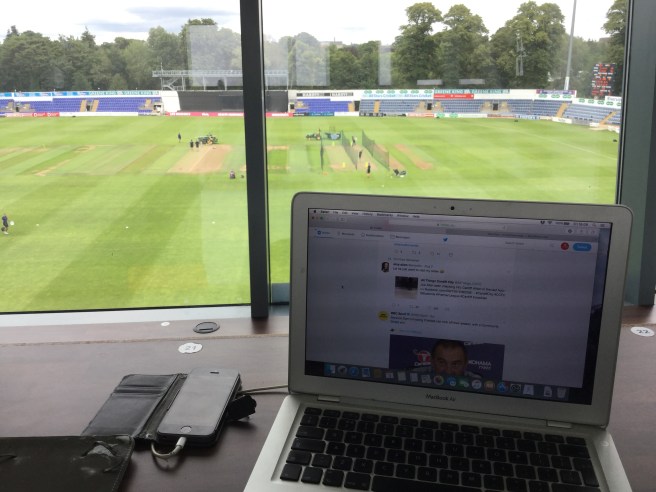
We are hearing in the Media Centre that Ingram needs 15 off 6 to beat his own ridicu-record. It feels like a formality: spoiler, he doesn’t.

Cooke, perhaps sensing that he’s a comparative irrelevance, flips Bopara to deep fine leg. There’s an argument that he might have been better simply repeatedly dropping a one to get Kingram back in and maintain the momentum: this argument is strengthened when Bopara nails Selman first ball, l.b.w. and things inevitably have stalled.

113 for 5 and Wagg must face the hat-trick ball. He survives.

Essex have mixed things up and looked decent enough in the field. But Ingram has eased his way to 89, come the end of the 14th. You feel like another irresistible burst is a -coming and then… caught in the deep, off Bopara.

125 for 6, with no meaningful contribution from anyone else in the Glam line-up; this could peter out disappointingly, we fear. Wagg and Salter must produce.

Ingram (and possibly the coaches) might be forgiven for offering icy stares and swear-words all round as the innings does indeed threaten to disappear.

Extraordinarily, after 16 overs, with Salter leaving us, Ingram is the only player to breach the boundary. Killer stat, right there. A nailed-on 200 is drifting to a likely 160 as we reach 138 for 7 off 17.

Bopara, numberless, is back. Smith slashes him wide of mid-off for a much-needed four, then cuts him square for another. Follows that with a contemptuous wallop through cow corner – having picked a very slow slower ball early. Some encouragement as Glam reach 155 for 7 by the end of the 18th. Quinn will bowl the penultimate over, from the River End.

Wagg absolutely clonks him to leg, first ball – middled and massive. He’ll be looking for 20 from the over: he exceeds that by six.

Seems inadequate to talk of ebbs and flows in T20: more like raging floods and desperate micro-calms.

Late on, from nowhere, Wagg and Smith invent the second partnership this innings desperately cried-out for. 198 for 7, we finish, with both Wagg and Smith undefeated – on 53 and 22 respectively. Strangely unbalanced, that; unaccountable, somehow.

Wheater and Chopra are the openers for Essex. They have an early dig, with Hogan responding by bowling full, full, with mixed success. 23 for 0 off 2.

Smith, from the River End, slaps a couple into the deck. Wheater connects with one off a decent length to swish him through midwicket for four, but carts the next to deep square, where he is easily caught. Walter joins Chopra and we sit at 30 for 1 after 3.

Walter is six foot nine, apparently, in old money – the language of the Media Centre. In that same illuminating tongue one of us personifies him eloquently as ‘looking like a bloody monster’. (A confession, at this point: it was me).

Van der Guten replaces Hogan, running away from us but there is no further joy for Glamorgan. Hogan, in fact, has changed ends and now charges in from the tree-lined Taff. He concedes a four through midwicket but then beats Walter with a quick one outside off. Good over – 6 from it.

Van der Gugten is a touch short of luck, barrelling in and spearing for the sticks but only finding a scruffy edge past the vacant leg-slip area. Hogan has a gentle word. Last ball also squirts past the keeper’s left hand, mind. 61 for 1 off 6.

Meschede is on and immediately makes an impact, Walter being snaffled superbly at mid-on. Shadows beginning to bloom under the lights.

Ingram is in for the eighth. No real sign of spin but he bundles through relatively unscathed.

Meschede is running in with some urgency. When he drops a tad short Salter makes a good stop at backward point.  Decent spell for Glam.

Salter is in, from underneath us in the Media Centre. Looks to me that he’s really been looking to extract a wee bit more, of late; he stays flattish, quickish, understandably so, with his off-spin but there are revs on the ball. He may be a tad unfortunate that the pitch here tends to offer little in the way of assistance.

Wagg follows, losing some pace, bowling some gentle comeandhaveagoifyouthinkyou’rehardenough cutters. Smith changes ends, with things feeling ver-ry even: required rate 10 (give or take), score now 112 for 2 off 12.

Chopra has medium-quietly gone to 50 for the visitors, as dusk falls. Wagg, returning,  has his wily head on again- successfully so – until his final delivery clears the the square leg boundary.

Magic Man Ingram again stirs the relative peace, bowling ten Doeschate for 28. We welcome in Bopara, knowing that he’s, as they say, ‘well capable’.

VDG claims what may be the key wicket of Chopra, who skies one, in trying to clear his arms: Cooke pockets it watchfully. Chopra’s 54 came off 41 balls.

The evening has gone from dusky to batty. We are back with Ingram, with Zaidi and Bopara coiled. Runs come but not decisively, you feel.

VDG will bowl the 17th. Bopara steers him rather beautifully over mid-off – six. Glam need a wicket.

Zaidi does everything to offer one, firstly by swinging wildly across something which nearly cleans him out, secondly by lofting to long-on, and the grateful Smith. This will surely be close. Hogan.

Peach of a yorker then six over mid-on. Storms and calms. Much tactical rearrangement. Another good yorker. Then too much width – it’s slashed away through third man. 167 for 5, 32 off 2 needed.

Wagg in again from the river. Around the wicket. a poor full-toss gets clattered over long-on. Six. Forgiven when Harmer finds backward point next delivery. 175 for 6 at the end of a good over. Hogan has 24 to play with.

The endgame. Two boundaries, meaning 16 off 4. Becomes 14 off 3 – Bopara facing. Six! Dot ball! Dot ball to finish, Glamorgan winning by 6 runs.

Hogan has closed it out again. He may not be the biggest threat in the division but the fella is impressively, sometimes imperiously cool at the death; genuinely rate him for that. Another win for Glammy – four in four – and that Finals Day Mad Day Out may yet streak towards us – possibly literally.


The Universe Podcast 2: with Matt Thompson, Talent Programme Manager for Cricket Wales

DDC91EB1-C951-4E80-93E6-482D8F6E1586

In the second of my amiable meanderings through what-might-turn-out-to-be the Definitive List of Movers & Shakers in Welsh Cricket, I chat to Matt Thompson, Talent Programme Manager for Cricket Wales.

Matt is a brilliant 26 year-old cricketer/lecturer/coach, with a ridiculous c.v.

Despite this, I kinda liked him. We talked the new job through – criminally unedited – plus all kinds of coach-feely other stuff.

Have a listen.


The Universe Podcast 1. @cricketmanwales meets Mark O’Leary… & talks MCC University Cricket.

Please note that this post is very much a companion piece to the preceding feature – On #firstclasscricketersfirstclassdegrees.

I spent some time with Mark O’Leary – Head Coach at Cardiff MCCU.

It’s not what you might call hard-hitting journalism. In fact it’s not journalism. I like the bloke; we talked.

O’Leary is something of a rising star – ECB Elite Master Level 4 Coach, workshop maestro, deviser of wittily wicked drills – who combines the cricket role with teaching on the Cardiff Met academic staff.

We talk about everything from funding, to honoured alumini, to the future for the scheme. Have a listen.

The sharp-eared may notice mention of £76,000 at the ver-ry end of the discussion. This of course related to Mr O’Leary’s fee.


On #firstclasscricketersfirstclassdegrees.


This slideshow requires JavaScript.

Friends we can be pretty sure that Messrs Bayliss and Farbrace don’t order the kit, sort the stop-overs, book the buses and the umpires. They don’t frame their work around ‘equally important’ other stuff – for the players, I mean – academic stuff. Mark O’Leary does.

He does because he’s the Head Coach at the Cardiff M.C.C. University Scheme. This as many of you will know is the project that for two decades has offered both a route in to professional cricket *and* the safety net of a university education.

Initiated by the inimitable Mr G Fowler Esquire of Durham and now based around six centres across England and Wales, the scheme has played a significant role in the careers and indeed the lives of (to take current figures) some 26% of county cricketers.

But even this apparently strong result in the value-for-money department has not rendered the project immune from the administrative/cultural/fiscal or accountability-driven revolutions carving and helicopter-shotting their way through the cricket landscape.

Recent features of that hypnotic but not always helpful flux include the M.C.C. pulling out after years of noble and very much-appreciated support, business (i.e. Deloitte) pulling in, and – within the last week or so – the E.C.B. confirming that they will bankroll things, post 2020.

There had for many us been a sense that after years of low-level uncertainty, a clear, bomb-proof structure needed to be in place and that if there can be such a thing, the ECB (the original funders) seemed the natural sponsor. However just how bomb-proof, how durable, how comforting on a day-to-day basis, is the future for the scheme looking?

As an outsider but interested party, I wanted to get a handle on how this felt from within: I scooted to the capital – to Cardiff.

Mark O’Leary is tall, tall and shaven-headed. If he lumbered a bit more you might place him somewhere rather worrying – like a tube-station, maybe, skulking with the rest of The Firm – but no.

He’s one of those big guys who gives off no darknesses. Refreshingly, there’s no ‘physicality’, no sense of a man asserting big-ness or power or dominance. He’s a light, open, smiley guy, welcoming me into a narrow, functional office, not some site-of-ambush.

I say this because O’Leary is a successful Head Coach, a team leader and a bloke about 6 foot five. One might expect a degree of machismo: I’m sensing none. He may not always be calm, quietish, affable and willing to listen… but he is now.

We talk and we go for a wander round the campus – Cardiff Met.

He describes the structure of the Cardiff Process and the responsibilities he has. He stresses the genuine gratitude he feels towards the now-departed M.C.C. for their central role, not just in having the vision to fund the scheme but also, more personally, the opportunity it has afforded him to develop himself over time, through experience.

O’Leary, like his counterparts at the other centres, really is everything from coach to logistics man to quality-controller of the whole cowabunga; even more so than his opposite numbers, as the Welshman also lectures on the academic curriculum.

Sure, certain specialist roles are delegated – for example to the Strength and Conditioning or Sports Psychology team – but the Head Coach is all over everything else.  He describes this epic multi-skilling modestly, in entirely philosophical fashion, free of any of the eye-rolling many of us coaches get drawn into when relating the menial stuff, the crèche-control-thing that most of us have to endure.

My guided tour is similarly conducted in an open, engagingly informative way. A friendly word to everybody; a quiet affirmation of respect for the S & C guys, ‘whom I really should meet’; a nod to the world class stat-analysis and athlete-monitoring systems, which O’Leary oversees but sidesteps any particular credit for.

We spend time in the gyms – where the 23 players do three, testing S & C sessions a week, starting at 7.30 a.m. We linger in the ungenerous office/corridor space that is the beating heart (lols) of the Strength & Conditioning Department. Peering out I imagine visiting sixth-former applicants gawping at the magnitude of both the facilities and the challenges they are applying themselves towards: ‘awesome’.

At the perimeter of the spectacular indoor tracks – yes, plural – Dai Watts (Lead) and Chris Edwards (S & C Coach) brief me, with just a touch of quiet pride, on personal training plans, scheduling etc etc.

Dai is employed by the university across a variety of sports. Dipping briefly into anorakdom, he nevertheless makes clear that a) the cricket at Cardiff Met is kosher, in terms of the integrity and commitment required for professional sport and b) that the O’Leary curriculum is fully fit for purpose in respect of the aspiration towards exceptional performance. Crucially, I also sense that these guys between them make sure that the House of Pain is also a House of Fun.

Without any whiff of sycophancy, Mr Watts plainly respects the cricket bloke: I suspect, given the S & C man’s demeanour and own, impeccably high standards of work, this is a privilege not always gifted.

A further detail from our tour. Outdoor facilities; immaculate 3G pitches, athletics field, track – all that – tick the boxes, emphatically. But look closer. Cameras.

O’Leary expands on this. The cameras are providing extraordinary levels of information for analysts, who then guide coaches and players on movement, discipline, tactics.

It escapes me at the time but on reflection this may be less relevant to the Cardiff M.C.C.U. than to their powerfully successful football and rugby equivalents: however I note it because the inference was absolutely that the cricketers benefit from precisely the same degree of support. That is, as O’Leary says, “world class”.

We retreat to The Office to chat further.

The Head Coach briefly recounts some salient, personal cricketty-info. He’s been coaching 26 years – implausibly, given I’d have stuck him in his late thirties – delivering across all age groups and abilities up to international (Wales) standard. He’s ECB Elite Master Level 4 qualified, has an MSc. in Sports Coaching and finds himself very much in demand; workshops, fielding sessions, playing for M.C.C. all this over and above the day-job.

Sparky, as he is known to friends and comrades, is perfectly content to discuss the state of the M.C.C.U. project and to reveal that over a period of time, the E.C.B’s hierarchy – in particular Mr Graveney – have been sounding out the current centres about plans for the future. (These talks have been somewhere between discreet and full-on secret).

O’Leary confirms that the E.C.B. have undertaken to take up the funding of the scheme in 2020 and that the talks have been encouraging in several ways. Firstly – dosh.

Figures have not been offered but O’Leary’s strong sense is that the E.C.B. want this to be professional and therefore to be funded adequately, at the very least. (“The aim is to develop professional cricketers”). They are consulting the Head Coaches to take a view on their individual university’s modus operandi, to keep them accountable but also very much to discuss the how and why of what works. Graveney is, to his credit, seeking guidance as well as preparing directives.

When I ask impertinently directly about money the reply is simply that Mark doesn’t know. There’s an assurance, a commitment but as yet no figures attached. O’Leary expects things to continue pretty much as they are but we talk about the possibility, raised in the media in the last few days, that other, probably additional centres may come in – that there may be a tender process.

Firstly, there is no sign of concern at this prospect; O’Leary being understandably quietly confident that the Cardiff M.C.C.U. should and indeed will thrive beyond any putative competitive scenario.

Secondly, the developments seem more about expansion than contraction, other centres being established at new venues. In our conversation the possibility is raised that funding may need to be spread more thinly over a bigger number of centres but… all hypothetical. O’Leary is planning to go on planning.

Guess what? I’m unashamedly a supporter of the scheme so offer the Cardiff man a freebie – the opportunity to make the case for his own process, his own course. Which brings us directly to the success stories, the names.

Or it would if either Mark O’Leary or myself accepted that this is just about transferring bodies into County Cricket. In a word, the Head Coach describes the rich combination of the whole Cardiff M.C.C University experience – education, discipline, bantz, performance-level sport – as “irreplaceable”.

Yes, the brief is to prepare able and talented cricketers specifically for a career in the sport but I imagine we’d all like to think (even?) the funders might get that this is bigger than cricket. (I know they do: the ECB are exploring possible community links to the scheme – prompting a diversion from yours truly, during our recorded conversation. Think Foxy Fowler; go listen).

A further brief note is in order, here. Mark O’Leary makes very clear in our podcast that there are three constituent parts to Cardiff MCCU – all of whom contribute significantly in terms of players and commitment. To give one example, Cardiff University – led by my old mucker Lee Herring won the British Universities & Colleges Cup (for cricket) last year and showed strongly in the Premier League South. The third element of the capital’s cricketing uni-scheme is the University of South Wales. I happened to visit Mark in his office at Cardiff Met. 

Heather Knight is maybe the highest profile name. World Cup Winner, world class player and captain: was at Cardiff. Jack Leach, who recently collected his first full England cap, likewise.

The trajectories, the angles vary. Jake Libby got into the scheme during his second year – it’s competitive and you have to re-compete, as it were, with every intake. Now has a three year contract at Notts.

Alex Thompson and Tom Cullen are particular sources of pride, for O’Leary, as they ‘came from nowhere’ and truly emerged during their time in Cardiff. Pro cricketers, former #crimsoncaps; i.e. part of the O’Leary Massive.

Of the current squad of 23, two are women. They work and train to the same level as the blokes, play in the university women’s team but are also involved at Western Storm (Taunton) where they get their elite cricket. It may be, incidentally, that one of the developments, come the ECB takeover, is a greater emphasis or investment in women players.

For obvious reasons there’s a strong, symbiotic relationship with Glamorgan. Many of the pictures adorning the O’Leary office feature past or present players, alumni of the scheme. Andrew Salter (formerly Cardiff Met.) has become a fixture in Robert Croft’s side; there will be more like him.Roughly a dozen of Glammy’s current first or second team squads are, or have been crimson caps.

To illustrate the diverse routes in and out we get to the example of Cameron Herring. Herring played three years of County Cricket before he entered Cardiff Met. He then brought an impressive and no doubt inspiring lump of nous and experience to the Cardiff side.

The stories go on; some tragic – Matt Hobden was a crimson cap – some hilarious and many which evidence both the completion of the Performance-Level Cricket Mission and the rich, holistic development we discuss in the podcast.

The whole points to a brilliant, well-executed programme borne aloft by the impressive and sustained commitment of students and staff alike. If the key aspiration for the man driving all this is to achieve Performance-Level Cricket Coaching, the box, for me is ticked.

However, I hear him noting that other boxes are available – are ‘irreplaceably’ a part of the Cardiff M.C.C. University package. O’Leary adds further that players may theoretically be temporarily dropped, if their academic work slips. So there is work, there is cricket work and there is camaraderie, fun: remember that?

As it happens, on the day of my visit, the universe, as so often, interveneth. Students are receiving their degree results. O’Leary politely absents himself in favour of the laptop screen, for a moment or two, as the scores come in. They’re really good.


The podcast/discussion around which this ramble is almost constructed, is on the way. Stay tuned!